
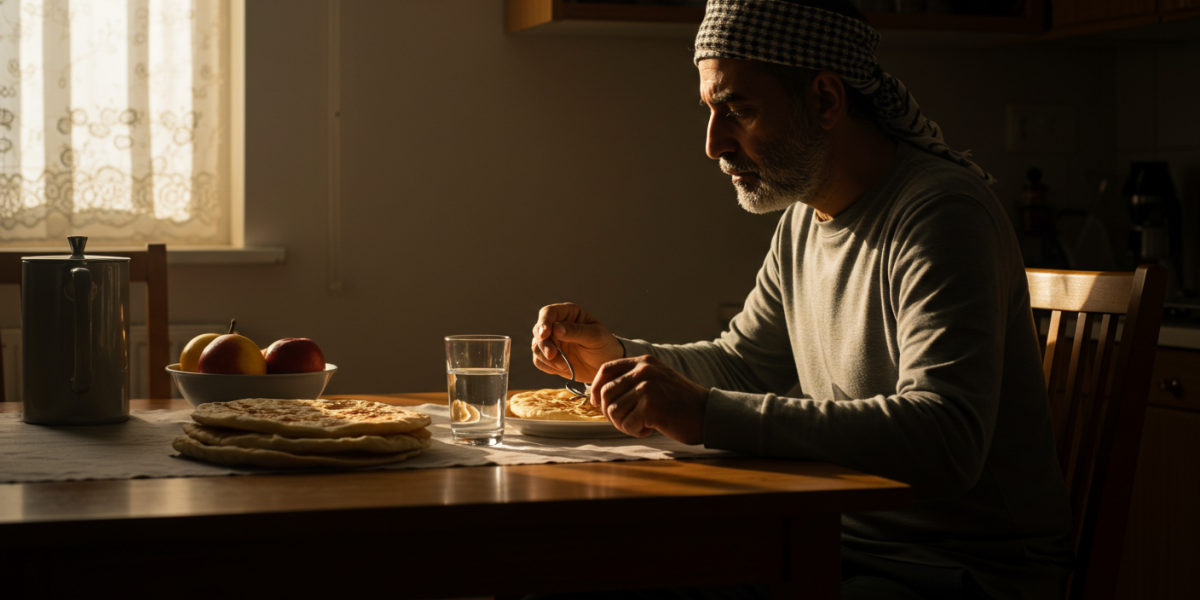
If you fast during Ramadan and you are also trying to make sense of a testosterone result, you have probably wondered whether the two are connected. It is a fair question. Ramadan changes when you eat, when you sleep, and the rhythm of your whole day, and all three of those things touch the hormone system that produces testosterone.
The honest answer is more reassuring, and more nuanced, than most headlines suggest. The fasting itself does not appear to do much to your overall testosterone. What can genuinely cloud the picture is when the blood is drawn and how well you have been sleeping. This guide walks you through what the evidence actually says, where that evidence is thin, and how to read a result taken during or just after Ramadan with the right context.
Does Fasting During Ramadan Actually Lower Testosterone?
This is the question most men arrive with, so let us start there. The short version: for most healthy men, Ramadan fasting does not seem to meaningfully change total testosterone over the month.
The strongest piece of evidence we have is a 2024 systematic review and meta-analysis that pooled 35 studies and more than 1,100 participants. It found no significant difference in testosterone, LH, FSH, or prolactin when comparing levels before and after Ramadan (Poursalehian et al., 2024, PMID 38781203, DOI 10.1371/journal.pone.0299695). A broader 2026 review of intermittent fasting reached a similar conclusion for men, describing neutral effects on testosterone, alongside a fairly consistent finding of reduced sexual desire during the fasting month (La Vignera & Condorelli, 2026, PMID 42280458, DOI 10.3390/nu18111817).
A smaller study of 45 men in Qatar fits that pattern: it found no significant change in testosterone, LH, estradiol, or DHEA-S across Ramadan, though sexual desire and FSH did drop (Talib et al., 2015, PMID 25923156).
Where I want to be straight with you: the underlying studies are mostly small, the fasting protocols differ, and a few older studies did report short-lived dips at certain points in the month. So the fair summary is not “fasting changes nothing, full stop.” It is “across the better evidence we have, the net effect on testosterone is small to negligible for healthy men, but the individual studies are mixed and modest in size.” That distinction matters when you interpret your own result.
Why Does the Timing of My Testosterone Test Matter So Much?
This is where the real signal is, and it has little to do with fasting itself.
Testosterone follows a daily rhythm. In men, it is typically highest in the early morning and drifts down through the day. That is not a Ramadan phenomenon; it is true year-round. Because of this rhythm, professional guidelines recommend measuring testosterone in the morning, in a fasting state, and confirming a low result on a second morning sample before acting on it (Bhasin et al., 2018, PMID 29562364, DOI 10.1210/jc.2018-00229).
Why this matters in Ramadan: your daily schedule shifts. You may be awake late after iftar, sleeping in fragments, waking for suhoor, and ending up at the lab at an unusual hour. A sample drawn at 2 p.m. after a short, broken night is not comparable to one drawn at 8 a.m. after solid sleep, and it can read lower for reasons that have nothing to do with a real testosterone problem. If you take one message from this article, let it be this: get tested in the morning, ideally between about 7 and 10 a.m.
Can Disrupted Sleep During Ramadan Affect My Result?
Yes, and this is the most underappreciated confounder of the whole topic.
Sleep is not a passive backdrop to testosterone; it is part of the machinery. Much of the daily testosterone rise depends on sleep itself rather than on the clock or the season, and short sleep, especially when it hits the first half of the night, can blunt testosterone (Wittert, 2014, PMID 24739309, DOI 10.1097/MED.0000000000000069).
The most cited experiment here restricted healthy young men to five hours of sleep for one week and measured a meaningful daytime drop in testosterone, on the order of 10 to 15 percent (Leproult & Van Cauter, 2011, PMID 21632481, DOI 10.1001/jama.2011.710). That was deliberate, sustained restriction in a lab, not Ramadan. But the principle travels: the fragmented, shifted sleep that many people experience in Ramadan is exactly the kind of disruption that can pull a testosterone reading down, independent of fasting.
So if your sleep has been poor and broken through the month, a single below-range result deserves a second look once your sleep normalises, rather than an immediate conclusion.
Do Meal Timing and Suhoor Change Anything?
Eating overnight and fasting through daylight inverts the usual feeding pattern, and there are a couple of practical implications.
First, food itself can transiently nudge testosterone down in some men, which is part of why guidelines specify a fasting morning sample (Bhasin et al., 2018, PMID 29562364, DOI 10.1210/jc.2018-00229). During Ramadan you are usually fasting by day anyway, so a late-morning draw is naturally fasted, which is convenient. The catch is the time of day, not the fasting.
Second, the same 2024 meta-analysis noted that Ramadan tends to lower morning cortisol and appears to nudge the body’s circadian rhythm (Poursalehian et al., 2024, PMID 38781203, DOI 10.1371/journal.pone.0299695). Cortisol and testosterone are part of the same broad stress-and-rhythm system, so a shifted internal clock is one more reason a single mid-month reading may not reflect your stable baseline.
I Noticed Lower Libido During Ramadan. Is That Low Testosterone?
Not necessarily, and this is worth separating clearly. Reduced sexual desire is one of the more consistent findings during Ramadan (Talib et al., 2015, PMID 25923156; La Vignera & Condorelli, 2026, PMID 42280458, DOI 10.3390/nu18111817). But in the same studies, measured testosterone often did not fall in step with it.
That tells you libido during the fasting month is driven by more than one hormone reading: shorter and broken sleep, daytime fatigue, dehydration, a packed evening social and prayer schedule, and simply less private time. A dip in desire during Ramadan is common and usually settles afterwards. It is not, by itself, evidence of a testosterone deficiency.
When Is the Best Time to Test Testosterone Around Ramadan?
Here is the practical playbook.
- Test in the morning. Aim for roughly 7 to 10 a.m., when testosterone is near its daily peak and most guideline reference ranges were built (Bhasin et al., 2018, PMID 29562364, DOI 10.1210/jc.2018-00229).
- Do not act on a single low number. A low morning result should be confirmed with a second morning sample, ideally on a different day (Bhasin et al., 2018, PMID 29562364, DOI 10.1210/jc.2018-00229).
- Factor in your sleep. If the month has wrecked your sleep, that alone can lower a reading. Where it is not urgent, it is reasonable to repeat the test a few weeks after Ramadan, once your sleep and routine have settled.
- There is no need to fast specifically for the test beyond the usual morning fasted draw. If you are testing during daylight in Ramadan, you are already fasted, which works in your favour.
None of this means a result taken during Ramadan is useless. It means it should be read with the timing and the sleep context attached, not in isolation.
What Should You Ask Your Clinician?
Bring these to your appointment so the result gets interpreted properly:
- What time of day was my blood drawn, and was it a morning sample?
- Should we repeat it on a second morning before deciding anything?
- Could my Ramadan sleep pattern have affected this reading?
- Was this total testosterone alone, or do we also need free testosterone, SHBG, LH, and FSH to interpret it?
- If I have symptoms but a borderline number, should we retest a few weeks after Ramadan?
- Are there reasons specific to my health that mean I should not wait?
Conclusion
Ramadan reshapes your sleep, your meals, and your daily rhythm, and all three intersect with testosterone. But the weight of the evidence suggests the fasting itself does little to your overall testosterone. What genuinely distorts a reading is the time of day it was drawn and how disrupted your sleep has been. Test in the morning, confirm a low result with a second sample, and read any number taken during the month with that context in mind. If your symptoms and your numbers do not agree, that disagreement is a reason to retest with better timing, not to panic. Be honest with your clinician about your sleep and schedule, and let the full picture, rather than one figure, guide the decision.
Related reading
- why morning testing matters for an accurate reading
- how sleep and testosterone are linked
- what SHBG adds to interpreting your result
References
- Poursalehian et al., 2024, PLoS One (meta-analysis, 35 studies, n≈1,107). DOI: 10.1371/journal.pone.0299695
- La Vignera & Condorelli, 2026, Nutrients (review). DOI: 10.3390/nu18111817
- Talib et al., 2015, Urol J (n=45). PubMed 25923156
- Bhasin et al., 2018, J Clin Endocrinol Metab (Endocrine Society guideline). DOI: 10.1210/jc.2018-00229
- Leproult & Van Cauter, 2011, JAMA. DOI: 10.1001/jama.2011.710
- Wittert, 2014, Curr Opin Endocrinol Diabetes Obes (review). DOI: 10.1097/MED.0000000000000069
